






A New Media Doctrine Vol. I · 2026

Readers scattered.
The feeds adapted.
MediaRank builds the return rails.

Previous architectures survived by narrowing. MediaRank reverses the equation — multiplying rediscovery paths across every adaptive feed, then routing readers back to the publisher.

Trusted Authority The factual core readers return to.
Adaptive Narratives Meet readers on every rail.
Multi-Perspective Distribution One story. Dozens of doorways.
Civic Memory Lasting memory for places and events.
Audience Synchronization Return paths from every feed.
Algorithmic Distribution Rediscovery at algorithmic scale.
The Fracture

The playing field changed. Audience behavior changed with it.

Readers moved onto algorithmically adaptive surfaces. The behavioral observability layer moved with them. Publishers kept producing the stories — but the return rails to bring readers back did not yet exist. The audience did not vanish. The path home did.

Two architectures compared. Old Architecture (Audiences leave for algorithmic feeds): the Daily News — one delivery, one moment — once reached the Local Newsroom directly, but readers now go elsewhere as algorithmic feeds (Social Feeds, Message Apps, Short Video, Niche Platforms, Search and Algorithms) decide what they see, narrowing the path to collapse. MediaRank Architecture (Build Return Rails): Smart Hooks, Rediscovery, and Intelligent Placement route audiences back to the Local Newsroom, with Measured Response, Continuous Learning, and Return Rails flowing outward — narrowing to multiplication. The Difference: the old model chases audiences across platforms you don't control; MediaRank rails work continuously to bring audiences back, producing more return paths, more readers, more loyalty, more impact.
01

Audiences Scattered Across Adaptive Feeds

The audience did not vanish — it distributed. Search, social, recommendation, and identity feeds became the new discovery surface. Those environments reward behavioral telemetry, not the institutional authority publishers had spent a century earning.

02

The Observability Layer Moved

Persistence, reactions, shares, conversation velocity, hook performance — the platforms could see all of it. Publishers had the reporting and the trust, but not the behavioral telemetry layer the new environments were built around.

03

The Audience Overlap Began to Disappear

As adaptive feeds increasingly reinforced different audience behaviors, publishers optimized toward the strongest visible response groups. Over time, broad civic identification weakened — and fewer readers returned through the same doorway.

An Interlude
Superior journalism was outflanked by superior telemetry.

The platforms did not win because they produced better reporting.
They won because they could observe, adapt, and recirculate attention around it.

Institutional journalism was competing against superior behavioral observability.

The platforms did not out-report the publishers.
They out-observed them.

Working note · MediaRank field research
The Asymmetry

The story does not run once anymore.

The platforms had behavioral telemetry. Publishers had the reporting. MediaRank closes that asymmetry without compromising editorial authority.

Publisher Strength

What newsrooms own

  • Original reporting
  • Editorial authority
  • Archives and institutional memory
  • Local trust
  • Editorial judgment
  • The publisher's own surface
MediaRank

The synthesis layer

  • Rediscovery intelligence across every rail
  • Hook refinement in flight
  • Surface-thread observation
  • Adaptive return-path ranking
  • Compounding learning per story
  • Audience routed back to the publisher
Platform Advantage

What the platforms had

  • Behavioral telemetry
  • Persistence signals
  • Reactions and shares
  • Conversation velocity
  • Topic heat measurement
  • Adaptive recirculation
Publisher story MediaRank rediscovery field Observed response Refined hooks Traffic returns to the publisher
The Return Architecture

One article should not have one doorway.

Every previous adaptation survived by narrowing the publication. MediaRank reverses the equation — multiplying the doorways around every story, then routing audiences back to the newsroom. Comprehensive coverage becomes the publisher's advantage again, not its liability.

Two models compared. The Old Model (One Story, One Doorway): a single article reaches a scattered audience along a few dashed lines, all converging into one downward path to the Newsroom. The Return Architecture (One Story, Many Doorways): the same article radiates through many gold and electric-blue rediscovery pathways out to a much wider audience, with multiple return paths flowing back to the Newsroom.
01

Simultaneous Discovery Surfaces

Every story appears across dozens of contextual hooks at once — civic rails, search rails, place rails, archive rails, identity rails, accountability rails. Discovery stops being a single doorway and becomes a many-pointed re-entry surface.
02

Return-Path Multiplication

One article becomes dozens of rediscovery opportunities. Readers re-encounter stories through context, time, and adjacency — not by algorithmic accident. The feed forgets; the rediscovery layer multiplies the ways back in.

03

Connective Memory

Places, people, events, and institutions stay connected across stories and across years. Newsrooms compound the value of their own back catalog — old reporting becomes a continuously rediscoverable asset, not a forgotten archive.

04

Contextual Exploration

Stories become nodes in a connected field, not items in a feed. One article opens a network of related public life — and every step of the rediscovery path ends on a publisher's surface.

05

Rediscovery Intelligence

MediaRank observes which rediscovery hooks persist, which pathways keep generating audience return, and which contextual surfaces keep resurfacing the story — then compounds that intelligence across every new article. The factual core stays fixed. The rediscovery infrastructure evolves around it.

The Inversion

Previous architectures survived by sacrificing reach. MediaRank turns comprehensive reporting into a rediscovery advantage.

Every adaptation that came before contracted the publication. MediaRank multiplies the surfaces around it.

Previous Architectures

The Contraction Model

Publication Narrower
Audience
Shrinking
Reach

Survived by sacrificing reach. The shared civic surface thinned along the way.

MediaRank

The Reconvergence Model

Factual
Core
Civic rail Search rail Place rail Archive rail Identity rail Accountability rail
Expanded
Reach

Multiplies rediscovery across every adaptive feed. Every doorway routes back to the publisher.

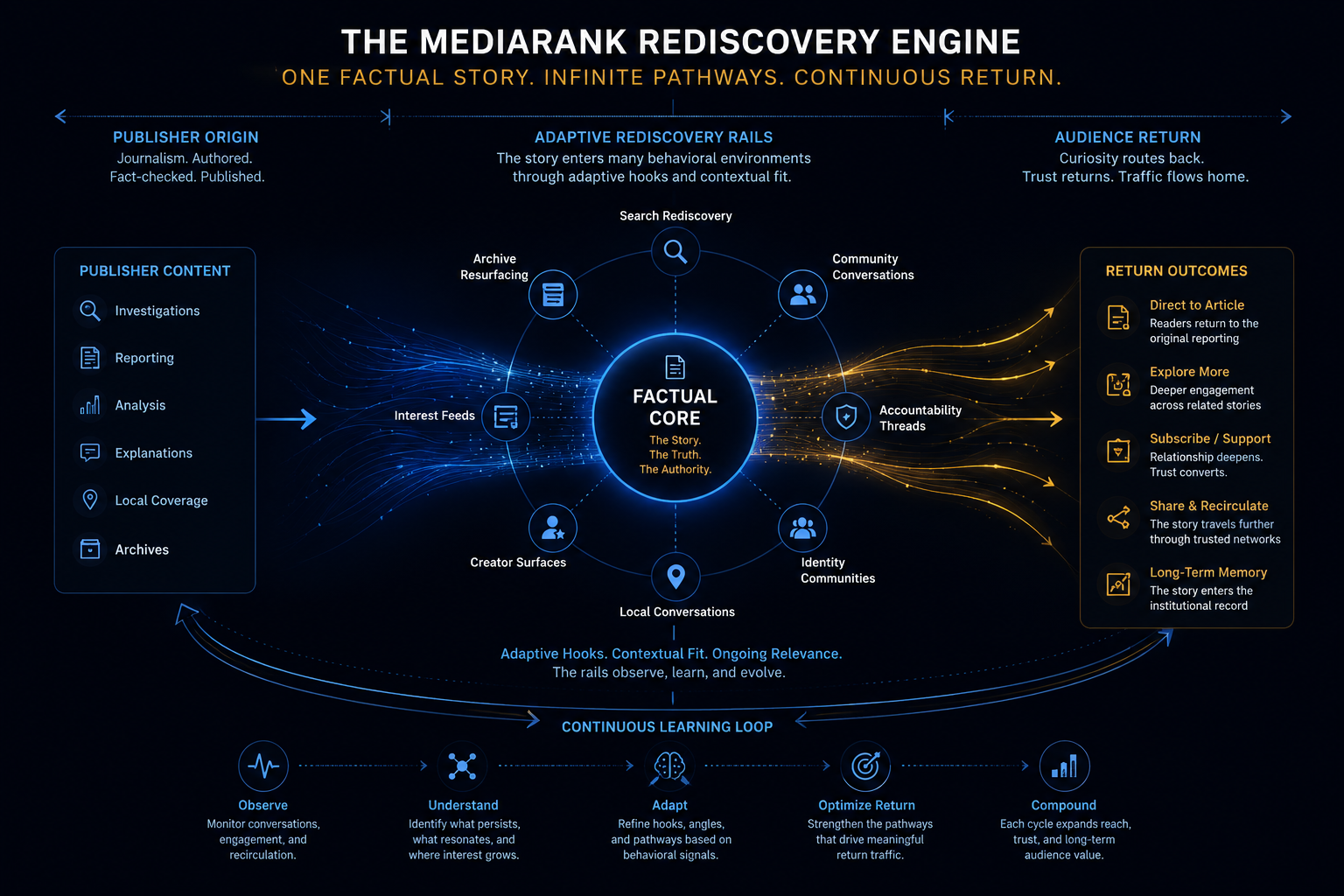
The MediaRank Rediscovery Engine — one factual story, infinite pathways, continuous return. The factual core flows out through adaptive rediscovery rails (Archive Resurfacing, Search Rediscovery, Community Conversations, Accountability Threads, Identity Communities, Creator Surfaces, Local Conversations) and routes audiences back to the publisher through return outcomes including Direct to Article, Explore More, Subscribe and Support, Share and Recirculate, and Long-Term Memory. A continuous learning loop — Observe, Understand, Adapt, Optimize Return, Compound — runs beneath the engine.
Doctrine
One article. Dozens of doorways. Every doorway leads home.

Audiences re-enter local journalism through whichever surface they already inhabit. The rediscovery layer multiplies the ways back in — and every path lands on the publisher.

The Publisher Win
The newsroom keeps the destination. MediaRank rebuilds the roads.

Publishers retain their article surfaces, subscriptions, ad inventory, reader relationships, and editorial authority. MediaRank does not trap attention. It routes it home, and enriches it along the way.

The Publisher Win

The newsroom keeps the destination. MediaRank rebuilds the roads.

Traffic returns. Subscriptions return. Audiences return. MediaRank is not a publishing tool, a CMS replacement, or a competitor for editorial authority — it is the rediscovery layer above the adaptive discovery environments publishers now operate within. It restores comprehensive civic reach as the publisher's advantage, not its liability.

I.

Civic Reach Restored

Every story appears across the rails audiences already inhabit. Each entry point routes traffic back to the newsroom that wrote it.

  • Simultaneous presence across every discovery rail
  • Long-tail relevance compounds story by story
  • Every doorway routes traffic to the publisher
II.

Publishers Protected

Audiences land where they always did — on the publisher's article surface. Subscriptions, ads, identity, and editorial authority all stay with the newsroom.

  • Publisher article surfaces remain canonical
  • Subscriptions, ad inventory, and reader identity preserved
  • Editorial voice and reporting authority untouched
III.

Rediscovery Compounds

Old reporting becomes a continuously rediscoverable asset. The longer the catalog, the more long-tail traffic the newsroom earns from it.

  • Back catalog compounds in value year over year
  • Rediscovery intelligence improves with every story
  • Every node in the rediscovery field returns traffic
The Restoration

The civic center returns. Audience return paths reopen. Trust returns. Local journalism returns to the center of public life.

MediaRank is not a publishing tool. It is the rediscovery layer that rebuilds the return paths — restoring comprehensive civic reach as the publisher's advantage, not its liability.

Rebuild the Return Rails →